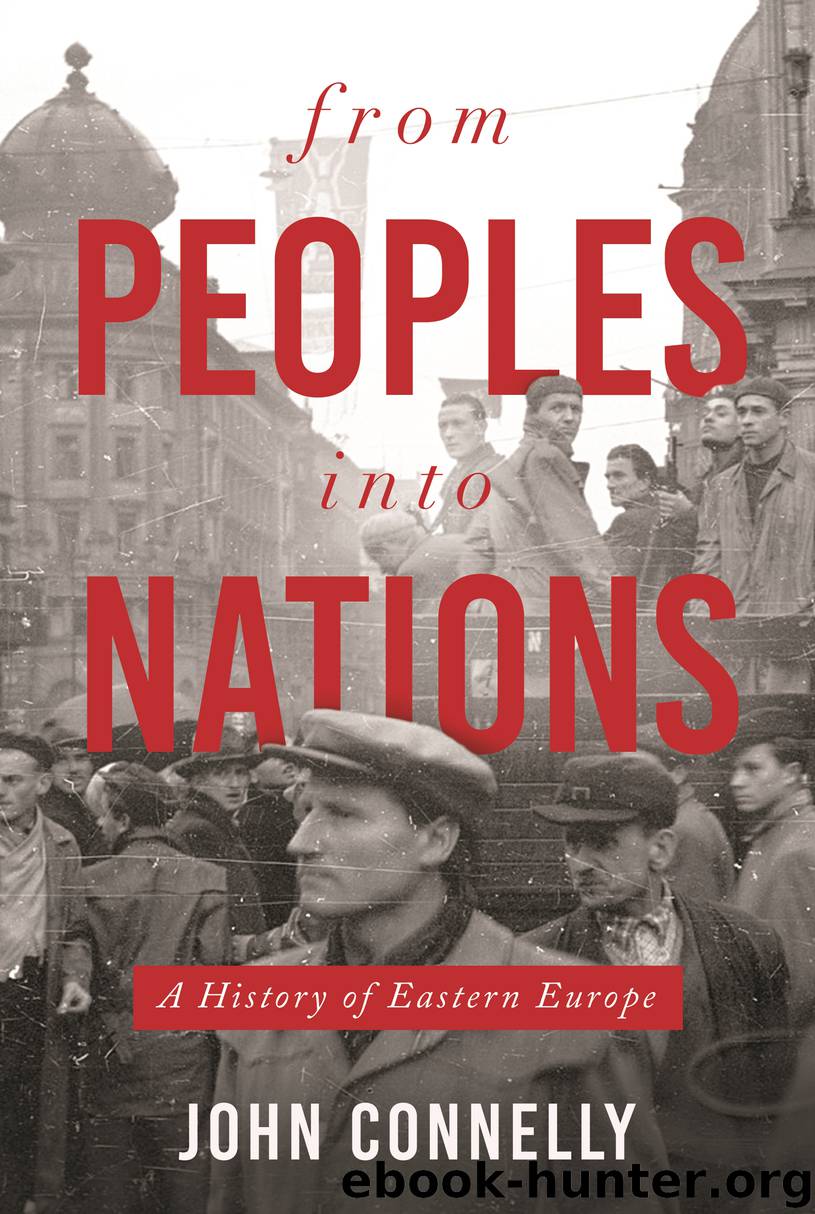
From Peoples into Nations by John Connelly
Author:John Connelly
Language: eng
Format: epub, azw3
Publisher: Princeton University Press
Published: 2019-11-10T16:00:00+00:00
Societies and Nations
Communists proclaimed that true workers had healthy class instincts that made them vigilant against enemies. Thus workers, peasants, and their children were targeted in recruitment not just to higher education but also to the Communist Party, the people’s army, and police forces, all of which would provide access to better grocery stores and vacation houses. The ultimate effects of this favoritism were ambivalent. At times, industrial workers took the party at its word—they were the ruling class—and were the first to express dissent in times of crisis, for example, in Czechoslovakia and East Germany in 1953.12 Yet at other times—Czechoslovakia and Poland in 1968—industrial workers proved a bastion of support for the regime. Workers or peasants who supported people’s democracy helped realize social justice while themselves becoming direct evidence that the new system kept its promises. They found career paths opened to them in state administration and the economy that their parents could not have dreamed of.
Intellectuals were generally of “bourgeois” background and destined to lose privileges in a worker and peasant state, yet many cooperated in building people’s democracy. Top writers, painters, and professors supported the regime with poems, stories, plays, films, and musical scores that celebrated Soviet-style socialism. They were blissfully ignorant of the object they admired. No journalists had been permitted to investigate life in the Soviet Union, and few outside the Soviet leadership knew the extent of the misery of collectivization or party purges of the 1930s. Did tens or hundreds of thousands perish? No one could say. Left-wing critiques of Stalinism by Arthur Koestler, Victor Serge, or Boris Souvarine that checked Communist sympathies in France were deemed anti-Soviet and could not appear in Eastern Europe. Native Communists who returned from Soviet exile and knew about famine or terror first hand, kept that information to themselves, still fearful of Stalin’s long reach.13
Yet even intellectuals who had tasted the terror and deprivations of Soviet reality often collaborated happily with the new regime. Communism found supporters among Polish writers who had seen friends arrested when the NKVD apprehended Home Army soldiers who wanted to fight alongside the Red Army. Others had survived Soviet camps or had close relatives who had not, yet they found ways to make peace with the regime.
Part of the explanation was lack of choice. When intellectuals returned to Kraków or Warsaw or Łódź in 1945 and wanted to continue their careers, they encountered a new state in the making, called “People’s Poland,” allied with the Soviet Union, involved in “rebuilding the country”—and not building socialism (at least not yet). What was the point of standing by idly? Did intellectuals not have a duty to Polish culture regardless of regime? Professors and teachers who had conducted classes in the underground now simply moved back into university and school buildings, for example, the critical non-Communist philologist Kazimierz Wyka, who has been likened to a practitioner of “organic work” from the late nineteenth century.14 Simple cooperation often evolved into subtle forms of collaboration. In 1953,
Download
This site does not store any files on its server. We only index and link to content provided by other sites. Please contact the content providers to delete copyright contents if any and email us, we'll remove relevant links or contents immediately.
| Anarchism | Communism & Socialism |
| Conservatism & Liberalism | Democracy |
| Fascism | Libertarianism |
| Nationalism | Radicalism |
| Utopian |
The Secret History by Donna Tartt(19092)
The Social Justice Warrior Handbook by Lisa De Pasquale(12190)
Thirteen Reasons Why by Jay Asher(8912)
This Is How You Lose Her by Junot Diaz(6888)
Weapons of Math Destruction by Cathy O'Neil(6281)
Zero to One by Peter Thiel(5802)
Beartown by Fredrik Backman(5756)
The Myth of the Strong Leader by Archie Brown(5509)
The Fire Next Time by James Baldwin(5447)
How Democracies Die by Steven Levitsky & Daniel Ziblatt(5219)
Promise Me, Dad by Joe Biden(5154)
Stone's Rules by Roger Stone(5088)
A Higher Loyalty: Truth, Lies, and Leadership by James Comey(4964)
100 Deadly Skills by Clint Emerson(4926)
Rise and Kill First by Ronen Bergman(4790)
Secrecy World by Jake Bernstein(4753)
The David Icke Guide to the Global Conspiracy (and how to end it) by David Icke(4720)
The Farm by Tom Rob Smith(4514)
The Doomsday Machine by Daniel Ellsberg(4490)
